Palma in stone: an architectural walk through the old city
Palma is a city best read on foot. Within a short walk you pass from a bathhouse of the Islamic city to a Gothic cathedral, from a royal palace that began as a Moorish fortress to shopfronts curling with early twentieth-century ironwork. The materials barely change: golden local stone, timber, lime and iron. This guide takes the landmarks of Palma in roughly chronological order, then gathers them into a route you can walk in a morning, with a separate climb to Bellver Castle.
La Seu: the cathedral that faces the sea
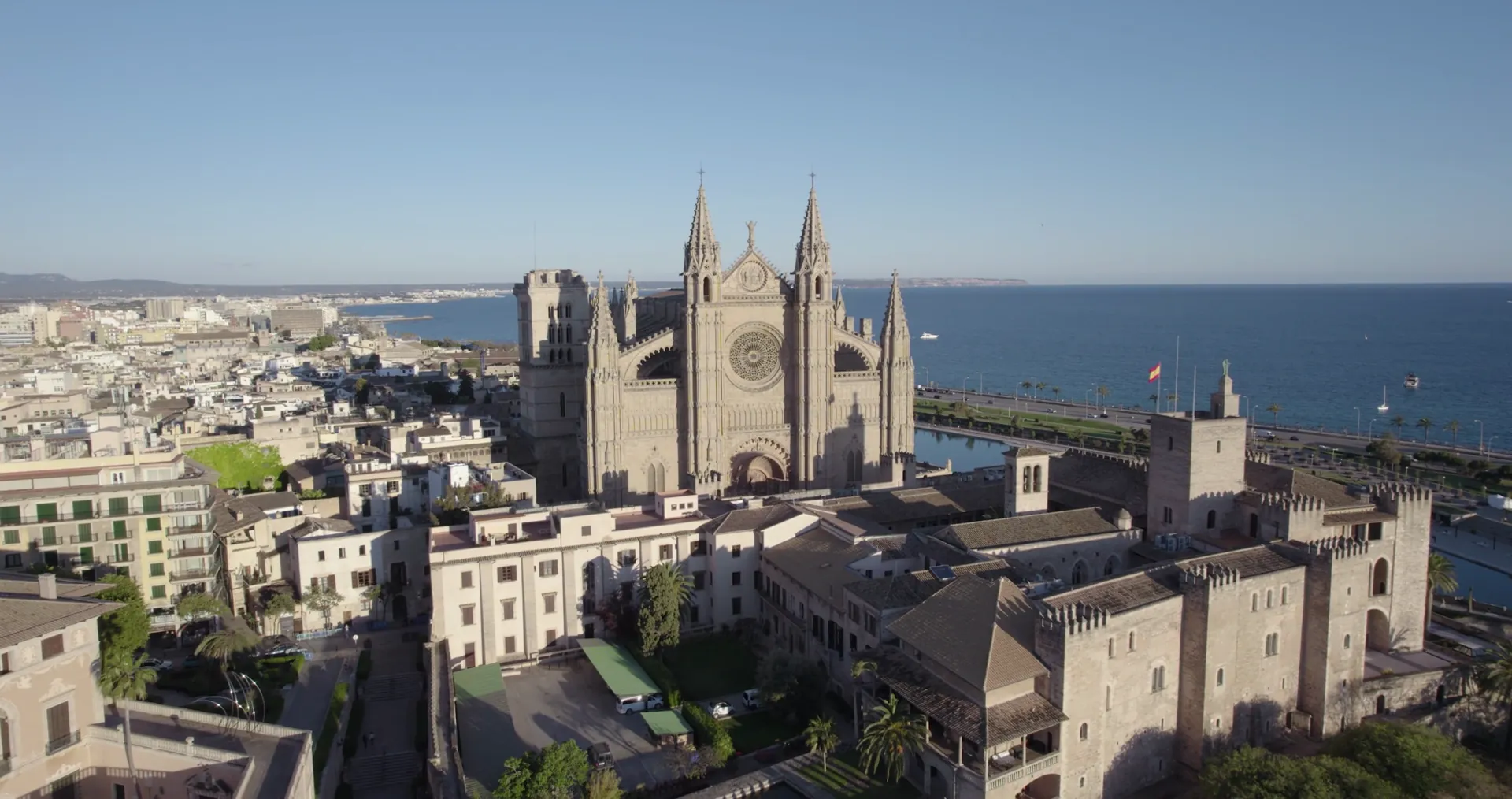
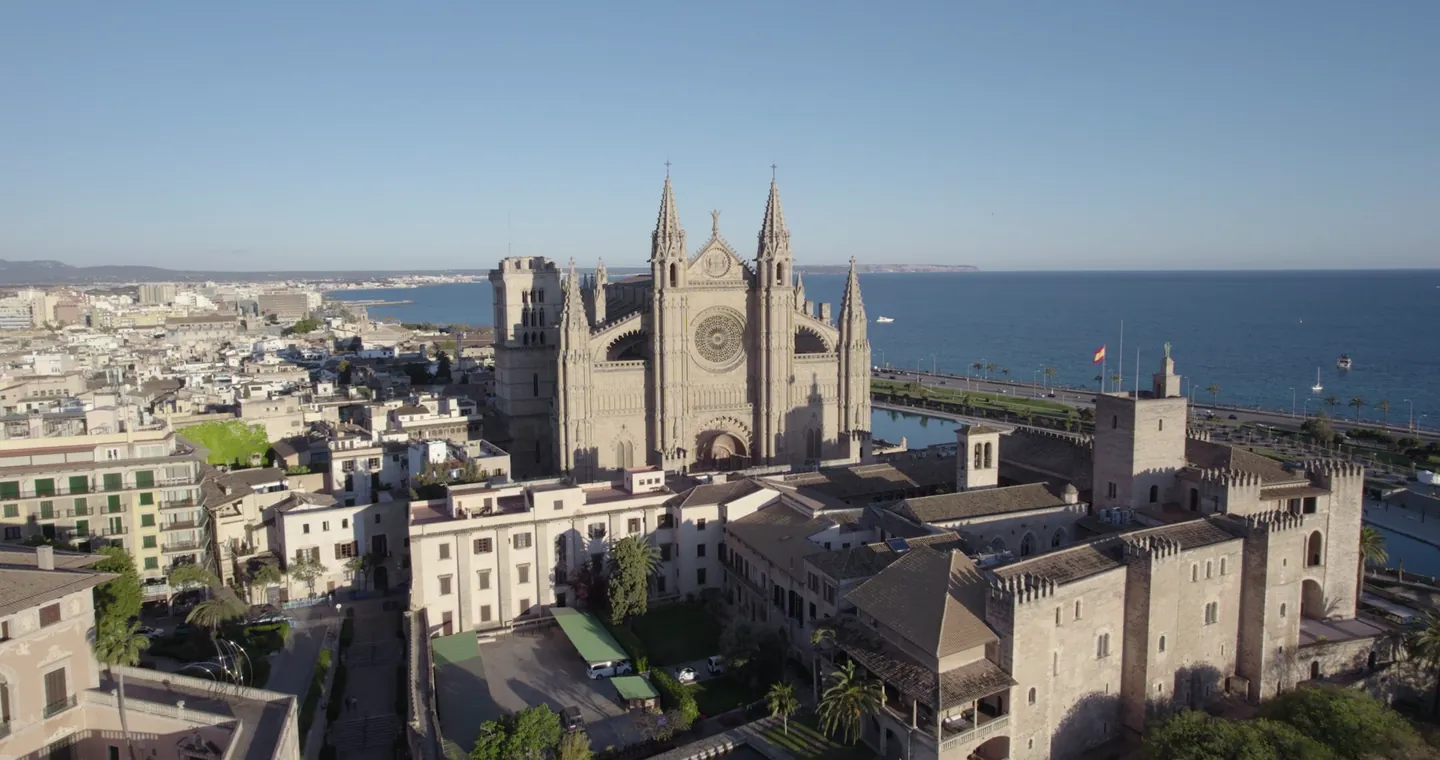
When Jaume I of Aragon took the city in 1229, the main mosque was turned into a church, and work on a cathedral began on the same site soon afterwards. Building went on for centuries. The result has one of the highest Gothic naves in Europe, carried on slender octagonal pillars and lit by a great rose window above the altar. Seen from the bay, its flying buttresses lined up along the sea wall like oars, it still defines the city.
Two later interventions changed how the interior feels. In the early twentieth century Antoni Gaudí was invited to renew it: the choir stalls were moved out of the middle of the nave, opening the long view towards the altar, and a huge crown-like canopy hung with lamps was suspended over the high altar. Early in this century Miquel Barceló covered the chapel of Sant Pere in ceramic, a rippling clay skin of fish and sea creatures, fruit and loaves that retells the miracle of the loaves and fishes.
Come on a bright morning, when the stained glass scatters colour across the stone. On two mornings a year, at Candlemas in February and at Martinmas in November, the low sun shines through the great rose window and throws a disc of coloured light onto the west wall, just beneath the rose window opposite, and a crowd gathers to watch.
The Almudaina and the Arab Baths
Facing the cathedral across a terrace stands the Almudaina. It began as the fortress of the Islamic governors of Madina Mayurqa, as Palma was then called, and was rebuilt in the fourteenth century for the kings of the short-lived Kingdom of Mallorca, who gave it Gothic halls, a royal chapel dedicated to Santa Anna and its sturdy towers. It is still an official residence of the Spanish crown, used for ceremonies, and Patrimonio Nacional opens much of it to visitors.
The Arab Baths, in the quiet streets of the Calatrava quarter behind the cathedral, are among the very few buildings left from the Islamic city. The surviving room is small: a dome pierced with round skylights, raised on horseshoe arches and slender columns whose capitals do not match, probably taken from older buildings. Sit for a moment in the garden outside among the palms and cacti, and the city seems far away.

Bellver Castle and Sa Llotja
Bellver Castle crowns a pine-covered hill west of the centre. Built in the early fourteenth century for King Jaume II of Mallorca, it is that rare thing, a circular castle: a round courtyard ringed by two storeys of arcades, three towers set into the outer wall and a free-standing keep joined to the rest by a single arch. For long periods it served as a prison, and today it houses the city's history museum. From the roof terrace the whole bay opens out, with the port, the cathedral and the Tramuntana behind.
Down on the waterfront, Sa Llotja, the old merchants' exchange, is the masterpiece of the Mallorcan architect Guillem Sagrera, who began it in the fifteenth century. Outside it looks like a small fortress with corner turrets and battlements; inside, slender spiral columns twist upwards like palm trunks and open into ribbed vaults. It was built for trade, not prayer, and the confidence shows. Today it is used for exhibitions, so whether you can go in depends on the programme.
Behind the doors: the patios of the old town
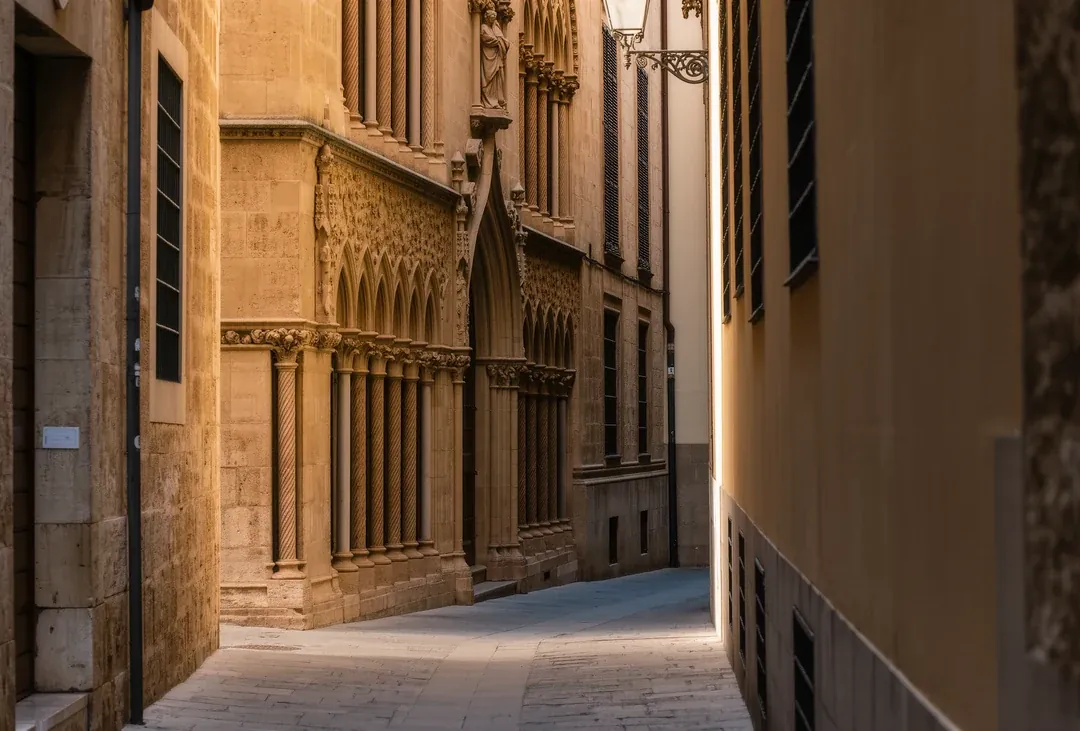
Palma's noble families built inward. From the street their mansions show heavy doors and plain stone; step to the threshold and a patio opens up, with wide, low arches, columns, a stone staircase climbing to the main floor and often a well or a few potted palms. Most took their present form in the seventeenth and eighteenth centuries, when older Gothic houses were remodelled in a more classical taste.
Many patios belong to private homes, but the great doors are often left open, and a quiet look from the entrance is generally accepted. The richest concentration lies in the lanes between the cathedral and the church of Santa Eulàlia, along streets such as Carrer de l'Almudaina, Carrer de la Portella and Carrer de Can Savellà. To walk into one properly, visit the Casal Solleric on the Passeig del Born, an eighteenth-century palace that the city now uses for exhibitions.
Modernisme: Palma's art nouveau moment
Around 1900 Catalan modernisme reached Palma, and a prosperous merchant class was eager to build in the new style. The landmark is the former Gran Hotel on Plaça Weyler, designed by Lluís Domènech i Montaner and opened in the first years of the century, its facade rich with glazed ceramic and floral decoration. It ceased to be a hotel long ago and now serves as a cultural centre with exhibitions.
A few steps away on Plaça del Mercat stand the two Casasayas buildings, twin blocks on either side of a narrow street, designed as a pair, their facades rippling like curtains. Beside Plaça Major, on Plaça Marquès del Palmer, Can Forteza Rey wears a skin of broken-tile mosaic and wrought-iron balconies, with a strange face peering out from the decoration. Look up throughout this part of town: modernista ironwork, stained glass and carved doors survive above many ordinary shopfronts.
Es Baluard and the walls by the sea
Palma was once ringed by Renaissance walls, built from the sixteenth century onwards to stand up to artillery and raiders from the sea. Most were pulled down in the early twentieth century to let the city grow, but the seaward stretch survives. The bastion of Sant Pere at its western end now holds Es Baluard, the museum of modern and contemporary art, where concrete and glass meet the old stone with real tact. Walk its ramparts for one of the best views of the bay.
East of the Almudaina, the Dalt Murada walk follows the top of the old sea wall above the Parc de la Mar and its long lake, with the cathedral rising beside you. In the park below is a large ceramic mural by Joan Miró, who spent his last decades in the city; his story is told in our guide to artists and writers in Mallorca.
A walking route through old Palma
Allow a full morning, more if you go inside, and wear soft-soled shoes: the old town is polished stone and steps. In summer start early, and see our guide to getting around Mallorca for parking and buses into the city.
- Start at Es Baluard and walk the ramparts, then drop down to Sa Llotja and the waterfront.
- Follow the Passeig del Born past the Casal Solleric, then climb to the Almudaina and La Seu.
- Walk the Dalt Murada above the Parc de la Mar and turn into the Calatrava quarter for the Arab Baths.
- Thread north through the patio streets to Santa Eulàlia and Plaça Cort, with its town hall.
- Continue to Plaça Marquès del Palmer and Plaça Major, then on to Plaça del Mercat and Plaça Weyler.
- Keep Bellver Castle for another morning or a late afternoon: take a taxi up and walk down through the pines.
Key points
- La Seu stands on the site of the main mosque; Gaudí reshaped its interior and Barceló clad the chapel of Sant Pere in clay.
- The Almudaina and the Arab Baths are the clearest survivors of Madina Mayurqa, the Islamic city.
- Bellver is a rare circular castle of the early fourteenth century, with the widest view of the bay.
- Most old town patios are private: look in quietly from the door, or walk into the Casal Solleric.
- Modernisme clusters around Plaça Weyler, Plaça del Mercat and Plaça Marquès del Palmer.
Questions
How long do I need for Palma's architecture?
A focused morning covers La Seu, the Almudaina and the patios of the old town at an easy pace. Add a second half day for Bellver Castle, Es Baluard and the modernista buildings, or if you want to go inside several monuments rather than admire them from the street. The island planner helps fit it into a longer stay.
Can you go inside La Seu and the Almudaina?
Yes. Both open to visitors outside services and official ceremonies, and tickets are needed for tourist visits. Times change with the season and with events, so check the current timetable before you go. Dress modestly for the cathedral, and expect queues on summer mornings, especially when several cruise ships are in port.
Is Bellver Castle within walking distance of the centre?
It is a steady uphill walk from the El Terreno district, partly on paths through the pine woods, and hard work in summer heat. Many people take a taxi to the top and walk down instead, which is easier on the legs and gives views of the bay and the port as you descend.
When is the old town at its best?
Early mornings outside July and August, when the light is low and the lanes are quiet, suit the patios and photographs best. The city's own feasts, Sant Sebastià in January and the Festa de l'Estendard on 31 December, fill the old town with life; see our festival calendar for the rest of the year.
Official sources
- Ajuntament de Palma
- Consell de Mallorca
- Patrimonio Nacional
Published 19 October 2026 by the editors of island mallorca. Facts were checked in autumn 2026; rules, timetables and access can change.